
Year: 2012
-
2012 in mobile phone photos
I enjoyed doing this post so much last year, I’m doing it again. 2012 was ‘a bit calmer than 2011, but a bit more exhausting’.

At New Year’s at the Mount, there was still Rena debris washing up.

Thanks to my four year old, I’ve enjoyed getting to know the wacky world of model railways.

I did a lot of bad food photography – I’ve left most of it off this post, except for CHIPS OMELETTE! H/T The Kitchen Maid.
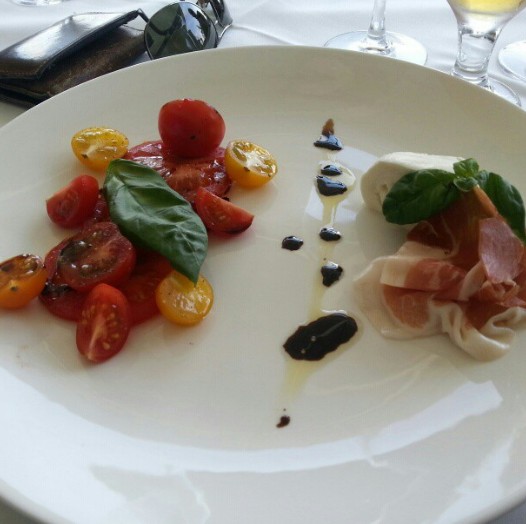
Lunch at Euro. Recommended.

I baked a lot of bread this year.

I also started blogging as part of the Corporate Lunchbox team – it’s fair to say my contributions have been sporadic so far. These burgers are from Char Grill.

I did enjoy a lovely meal at Depot.

The fantastic @cateowen let me sit in the 3 News chair. In fact, most of the cool shit I did this year is thanks to Cate. Ta 🙂

I got to be Jeremy Clarkson for a weekend.

And here is THE JUDGE!

Had yet another v. successful Lads Weekend, at ‘catching fish’ and ‘binge drinking’ levels.


Work-wise, I enjoyed myself thoroughly, even though it was another challenging year. Lot of issues, lot of change. I was even on the bloody telly at one point. I’m missing a lot of the folk in this picture.

The Telecom ONE unconference was another raging success, with bonus manly-disregard for safe trailer stacking practise.

My rugby team The Chiefs only went and bloody won the title. I was very happy.


The 40th birthday parties kicked right in.

Two childhood flashbacks – I fished these MAD magazine paperpacks from a paper recycling facility because HOW COULD YOU THROW THEM AWAY?!?!, and commandeered the family lego for my kids.

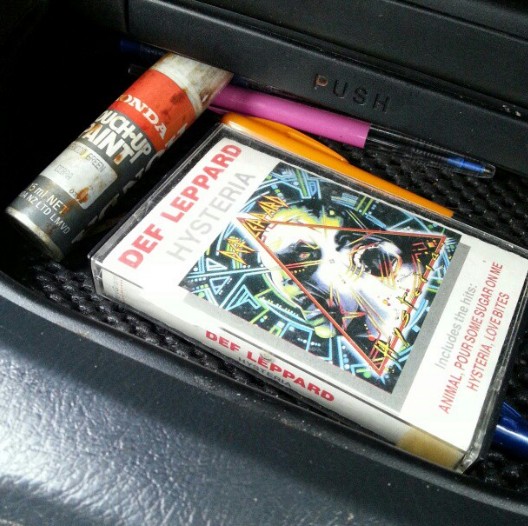
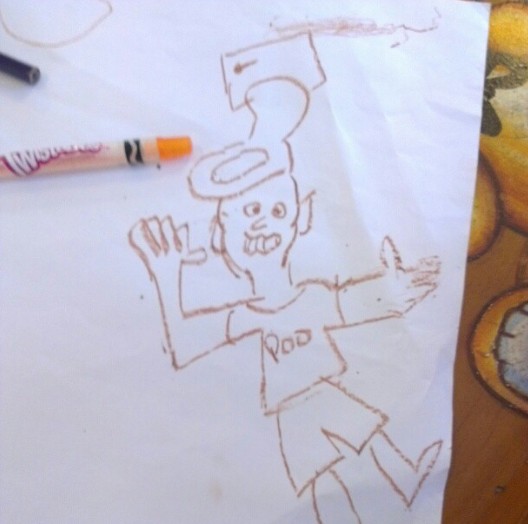
I got on Instagram, and found it’s useful mainly for taking photos of ‘things’, or close up photos of objects. They could be it Def Leppard tapes or drawings of a man with a toilet for a hat. For proper photos, it’s still Flickr.
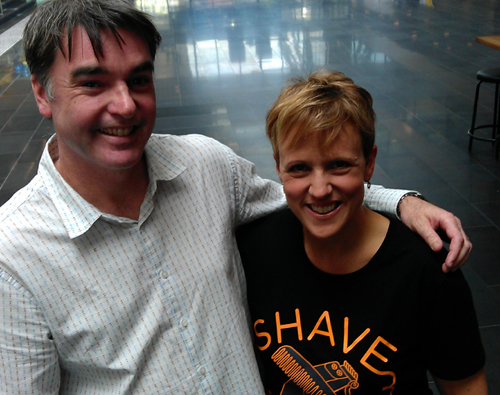
I met Hillary Barry. She was lovely and didn’t mind having her photo taken with Mr Arkward arm.
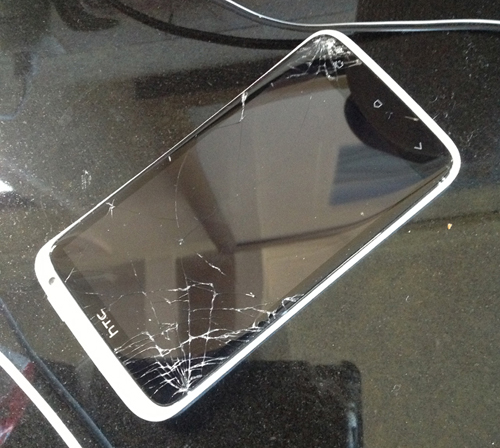
I had a STORMING year, tech-wise.
This photo is the remains of my beloved HTC ONE X – which I smashed, to be replaced (thanks to me bursting into tears in front of our FANTASTIC device team in a most un-manly fashion), with Samsung’s S3, which I also lurve. Both these phones are big, with bright, vivid screens and superb cameras. Fast. You name it. I rely on it / them a lot to get stuff done, whether it’s work, organising our chaotic weekends or just fecking about on the bus.
At home, I obtained an iPad 3 and the Apple TV for home. Will save the in-depth run down for a future post, but yeah, they’re all fantastic.

My wee chap and my wee girl (she’s a bit bigger now). Family is the whole point, team.

-
This ain’t no funky follow party
In the last month or two, I’ve been on an unfollow binge.
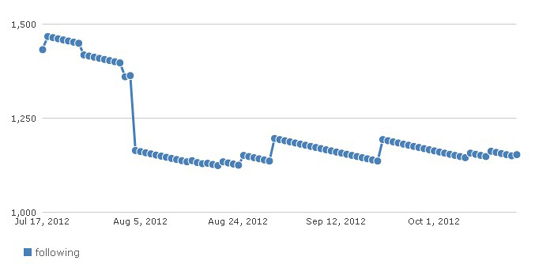
@richirvine ‘following’ stats July – October 2012 When starting out on Twitter, I followed my mates who had blogs, then sportspeople, then local media and online types. I was as free and easy with the follow button as I am with peanut butter on toast. I’d go through other interesting people’s follow lists and follow away with what turned out to be reckless abandon.
Like (I suspect) many professional SM-folk, I followed many people out of professional obligation. Competitors, customers, industry types – which is all well and good, but for the odd occasion they spoke up about something that may become an issue for the employer, the trade off was often a whole lot of irrelevance.
Slowly things became more and more out of control – people you thought would be fun turned out to be too noisy, too whingy, over share-prone or self obsessed. I’m loathe to begrudge anyone a decent bit of self-obsession (hey, check out the domain name of this site!) but this was *my* Twitter – I wanted it to be awesome.
I think everyone owes it to themselves to make their Twitter great. Those pithy little updates and avatars are much more personal and important to me than, say, Facebook with its ever-shifting rules, ads and stuff a mysterious, unaccountable algorithm thinks (THINKS?) I’ll like.
And so, I started unfollowing. My inspiration was this article, Why I just unfollowed everyone on Twitter. Killer quote: “It’s exhilarating.” Unfollowing *everyone* seemed a little extreme (quite tempting though!) but like eating chips, once I started, I found it hard to stop.
Many of the accounts were pure newsfeed accounts I’d long since lost interest in and had been mentally skipping over anyway. Many people were the professional-obligation crowd* and others were friends of friends I’d followed because they were friends of friends, but it struck me I was getting mentally involved with people I didn’t actually know. Which, on paper, felt weird. Unfollow.
Google has a few tools for managing Twitter followers, but I found it easier to just go through my follow list in a web browser and start unfollowing manually. It didn’t take very long, I unfollowed a 2-300 people and I’m much happier. My Twitter feels leaner, sharper and has more meaningful updates, better signal to noise ratio, all that.
Like any time I dramatically cut back on RSS subscriptions (here’s another good article) or what have you, I don’t miss it. And because I’m a recidivist offender when it comes to welcoming feeds, accounts or noise into my life that will easily distract me, no doubt I’ll have to repeat the process over at some stage, but I’m (generally) OK with it.
Yes, I’m aware this post makes me sound like a dick, but I assure you that’s not the intention – I just want my Twitter to be a nice place, and make it about what works for me rather than trying to be everyone’s mate. Or something. One of the things I love most about Twitter is that you control completely what you see and can quickly change it if it’s not working for you. Don’t put up with noise, claim back your Twitter people! For you!
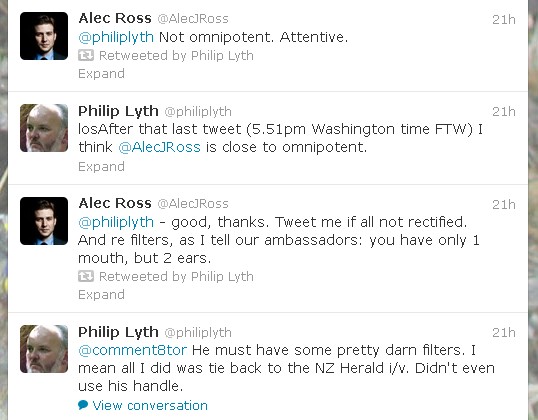
* This is a valuable search tab I have saved for making sure I don’t miss mentions of the employer, with the added bonus of seeing who says what about the employer when they think you’re not seeing it, by not using the handle.
-
Project [R]Evolution
A few thoughts on the recent The Project [R]Evolution conference.
I thoroughly enjoyed Dan Neely from the Wellington Regional Emergency Management Office – his points about responding fast, but accurately in a crisis resonated with me. It takes some maturity in an organisation to get on social media and say “we know there’s a crisis – we’re still finding out what’s happened, but we’ll let you know when we *do* have news.” It’s a reflection of today’s ‘always on’ society that Dan, like me, probably sits on his couch of an evening with a sneaking voice in the back of his mind saying ‘I wonder if something’s going wrong?’. Ahem.
Conference regulars Brown, Brislen and McDonald held an entertaining panel – there was refreshing honesty, and I enjoyed seeing panellists who didn’t completely agree on every point under discussion.
Alec Ross, Hillary Clinton’s Senior Advisor for Innovation was everywhere in his time in NZ, on the telly, radio, giving interviews and mixing it up with the locals on Twitter – impressively, showing up in conversations he wasn’t even taking part in. He stepped on stage looking like he’d just popped in from the set of the West Wing – his Powerpoint with huge ‘Power’ and ‘$’ slides created a slightly OTT and surreal feeling. His content was heavy on the history but light on the war stories from the Obama campaign, which the crowd (well, me) had come to see, but still, I enjoyed seeing a guy on top of his game present. His killer lines (“it’s a bad time to be a control freak”) were delivered with relish and style. Things got slightly lively in the Q+A with a Wikileaks question and half hearted heckle, but Ross handled it like a pro, defining the terms on which he was going to address it, then addressing it and moving quickly on. He’ll probably run the world one day.
I missed the most part of day two, but pitched up late afternoon, just in time for Christopher Barger – like I tweeted, I found much of what he said affirming and common sense, and I thoroughly enjoyed his tough guy myth busting shtick. If you were a largeish corporate business who’d never attempted social media before (are there any left?), his preso would be an excellent place to start.
Richard MacManus and Emily Banks were the ‘future web journalism’ one-two to end the day. Richard, who I imagine gets asked by checkout operators and service station attendants what hot new web publishing platforms they should be checking out, talked us through this blog post mainly, neatly summarising the developments that are slowly creeping up on our monitors and mobiles. Banks talked us through how Mashable approaches the new journalism landscape, as well as some more nefarious approaches. Which were, um, really intriguing. I’ve ordered a copy. Interestingly, she chose the ‘Coldplay’ clip from opinion-dividing The Newsroom to illustrate the ‘first’ and ‘not wrong for long’ pressures modern news outlets face.
Overall, the conference had a great tone, loosely based around change through technology, as well as a broader, historic perspective. Presenters like Michael Jones and Tim Forseman offered much food for thought. Jennifer Duval Smith‘s panel and the quickfire speakers (yay!) gave a board range of local angles. Refreshingly, social media was part of the mix, but not the focus. Which is better, I reckon. We *may* be at the point where we move beyond ‘hey, the internet exists, isn’t it awesome?’ and talk about what we do with it next. Well done to all the organisers.
As usual, the number one highlight of the conference for me was catching up with folk I don’t get to talk to very often, and meeting folk I felt like I knew already from the Twitter and that. It was a great turn-out.
PS: Here’s the slides.
-
On the box
So I was on the telly, along with Simone McCallum and Rick Shera talking about this ruling in Australia where by companies are responsible for everything that appears on their Facebook or social media pages.
My (expanded) view is that social media should be literally social – a two way conversation between companies, their customers and their online communities. Of course we keep a close eye on what’s on our page – like Rick says in the clip, you can’t just set up a Facebook page then forget it. We also make no apology for removing posts that are non-family friendly – much offensiveness is automatically headed off at the pass by our profanity filter (great to finally make use of my specialist profanity knowledge in a professional situation).
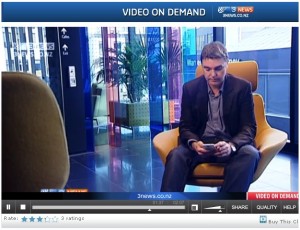
Getting a quick game of Angry Birds in. I’d personally be disappointed if a similar ruling here meant a moderation step before people could post on one of our pages. If we set our slate out and ask customers to let us know what they think, folk should be able to say what they like, within reason. A moderation step would make the whole exercise less, well, social.
As for the process of being filmed for the telly and that, it was fun if slightly nerve wracking. And weird to see yourself on the box, but I imagine once you reach full Brislen level, you’d be used to it! The kids loved it. My greatest concern was that one of my mates, seeing the ‘I get an email to my phone when there’s a Facebook comment’ comment would post mass hilarity on the page. Hasn’t happened. Yet. My phone went nuts on the night with relatives txting and kind people tweeting – thanks to everyone who tweeted, you are too kind.
-
Amazing what you find when you google yourself
Me, in a directors institute magazine. Who’d have thought?
-
Depot (and Bellota)

On paper, it’s easy to wonder if Al Brown‘s Depot is playing a Keyser Soze-magnitude trick on Auckland. No bookings, crowds to battle, wait for ages to sit outside drinking wine out of a tumbler, before being granted access to sit at the bar and eat upper-mid-range-priced food on sharing plates? Well, we did all the above, and still loved it.
We didn’t show up at Depot until after eight on Saturday night, which is quite possibly the worst time to go, but we gained entry at around half nine. The waiting-so-long-for-a-table blow is softened by Depot’s team – everyone is warm, welcoming and scarily efficient. There’s no mucking about once you’re in, drink and food orders are taken immediately, and dishes arrive magically on time as you finish the one previous. I guess the service HAS to be good – it was still absolutely heaving at almost eleven o’clock, and I can imagine Auckland’s dining public, hyped on Metro reviews and awards can be tricky to manage if things get out of shape.
As for the food – we shared the snapper tortillas (delicate and delicious), lamb ribs (melt in mouth stuff) and the Pork Hock as a main. With a crispy layer on top of some extremely tender meat, along with salsa verde and creamy mash potato, the challenge was to create little spicy, creamy, cracking perfect forkfuls every time. My only criticism of the food was the extremely generous servings of fat on the lamb and the pork, the kind you’d cut off if you were at home, but you wolf down when you’re out, ‘cos it’s a special occasion. There’s no doubt fat is tasty, and Depot is not afraid, to say the least.
We left plenty on the menu to explore (LIKE DESERT!), and we’ll be back, probably targeting a less frantic time of the week. I hear their breakfasts are very good. Depot is fantastic – and probably deserves its supreme award in the Metro. It’s a really different night out and the busyness and buzzyness are infectious. Recommended.
During our wait for a table, we snuck across to Bellotta – and had a great time. It’s a neat room, and two of the little tapas we had were sublime, the cassava chips and the dish with two types of sausages, fava beans and grapes. We’re keen to go back and try some more dishes there too, also recommended.
-
What did we learn?

This last couple of weeks I was lucky enough to:
Speak at the Social Media and Mobile Apps forum, with a Telecom case study; “Social and corporate values – making them play nicely”
Attend The Flying Social Network’s The Social Media Breakfast
Both were fine events, and they made me think about conferences and expectations. If there’s one thing ‘social’ ‘media’ has been good at, it’s creating conferences. And nobody is happy about them, if you read the Twitter commentary. They’re too ‘101’. They’re just an argument about why you should do social media. The presenters just read this shit on Mashable this morning*.
I’m just wondering what people expect. In the information-diarrhoea age we live in, there is no shortage of social media how-tos, gossip, case studies and news on the internet. It’s highly unlikely that a presenter will give birth, live on stage, to a unique information snowflake that will instantly make everything crystal clear and can be readily adapted to make your own SM strategy roar like a some kind of online Harley Davidson.
It’s worth remembering that this stuff is still new to most people, especially if they’re not among the daily-Mashable-reading set. It seemed to me that at the SoMo forum in particular, many of the audience WERE there for a 101. Fair enough, and that’s pretty much what they got for their money.
Over at Air NZ’s event, Wildfire’s Jessica Gilmartin gave a fairly 101 level presentation and the twitter hashtags lit up, railing against the basic level it was pitched at, as well as a lack of local case studies. But when Randi Zuckerburg gave her top ten ‘what’s hot’ tips, which included mobile, gamification and curation, the audience gave her a considerably easier ride than Gilmartin, despite many of the hot tips having been around long enough to cool off somewhat by now. It helped that RZ was generous with the war stories about Facebook’s early days and appeared relaxed, charming and to be thoroughly enjoying herself. She’s a great presenter, so folk were willing to forgive the content, which I dare say you could have largely googled up yourself, saving yourself the early start and $75.
So what about conferences then? Should you bother? Yes, because there’s other actual humans there articulating the problems and solutions they’re working on, both on stage and over shit coffee. There’s a limited pool of both presenters and potential attendees for social media conferences in NZ, so maybe we should just decide if we can take the time to attend, and if we can, STFU and take the day on its merits and enjoy meeting new folk and catching up with old ones. Or maybe I shouldn’t read so much into the Twitter conversation.
*Incidentally, at both these events, at least one presenter advised reading Mashable. One specified ‘every day’.